
Status: Shipped, phased rollout in progress. Post-launch metrics maturing.
Status: Shipped, phased rollout in progress. Post-launch metrics maturing.
RMS REVAMP · UX Research & Design Case Study
RMS REVAMP · UX Research & Design Case Study
Rebuilding RMS
Rebuilding RMS
Rebuilding RMS
Rebuilding RMS
From a System People Work Around to One They Work With
From a System People Work Around to One They Work With
From a System People Work Around to One They Work With
From a System People Work Around to One They Work With
A global UX research and redesign initiative across BCG Design Studios’ internal Resource Management System, covering Strategists, CPLs, Designers, Managers, and PMs across EMESA, AMR, and APAC.
A global UX research and redesign initiative across BCG Design Studios’ internal Resource Management System, covering Strategists, CPLs, Designers, Managers, and PMs across EMESA, AMR, and APAC.
A global UX research and redesign initiative across BCG Design Studios’ internal Resource Management System, covering Strategists, CPLs, Designers, Managers, and PMs across EMESA, AMR, and APAC.
1. Context & Problem Statement
1. Context & Problem Statement
1. Context & Problem Statement
The Platform
RMS is BCG Design Studios’ internal resource management system, the platform meant to be the operational backbone for how a global creative organization scopes work, staffs teams, tracks hours, manages billing, and stores delivered output. It is used daily by 1,500+ people across five distinct personas: Strategists, Creative Project Leads (CPLs), Designers, Design Managers, and Project Managers/Ops, spanning three regions: EMESA, AMR, and APAC.
RMS is BCG Design Studios’ internal resource management system, the operational backbone for how a global creative organisation scopes work, staffs teams, tracks hours, manages billing, and stores delivered output. It is used daily by 1,500+ people across five personas and three regions.
RMS is BCG Design Studios’ internal resource management system, the operational backbone for how a global creative organisation scopes work, staffs teams, tracks hours, manages billing, and stores delivered output. It is used daily
by 1,500+ people across five personas and three regions.
The Symptom
RMS was supposed to be the single source of truth. In practice, it had become something people built workarounds for, not a tool they relied on. Every persona we spoke to kept a parallel system running alongside RMS: personal Excel trackers for revenue, Slack threads for real project status, Jira for task granularity RMS couldn’t capture, and informal check-ins with PMs because, as one Strategist put it, the system itself was never trusted enough to be the last word.
RMS was supposed to be the single source of truth. In practice, it had become something people built workarounds for, not a tool they relied on. Every persona we spoke to kept a parallel system running alongside RMS: personal Excel trackers for revenue, Slack threads for real project status, Jira for task granularity RMS couldn’t capture, and informal check-ins with PMs because, as one Strategist put it, the system itself was never trusted enough to be the last word.
“Even when I check RMS myself, I always follow up with a PM to confirm, because the PM, not the system, holds the real and reliable knowledge about a project’s status.”
- Marc, Strategist, AMR
“Even when I check RMS myself, I always follow up with a PM to confirm, because the PM, not the system, holds the real and reliable knowledge about a project’s status.”
- Marc, Strategist, AMR
Why This Mattered
This wasn’t a cosmetic UX problem. Broken search cost Strategists billable hours hunting for past work. Inaccurate time-tracking meant Account teams couldn’t tell clients, in real time, how much budget had actually been spent. Revenue generated through business development was silently lost when client records weren’t attributed back to the Strategist who built the relationship. Designers were losing 30–45 minutes a day to administrative overhead just to keep RMS technically up to date, time that didn’t serve clients or the work itself.
The brief: understand why RMS had become a tool people worked around rather than with, and redesign it so that it earned back its position as the system of record, for every persona, not just one.
This wasn’t a cosmetic UX problem. Broken search cost Strategists billable hours hunting for past work. Inaccurate time-tracking meant Account teams couldn’t tell clients, in real time, how much budget had actually been spent. Revenue generated through business development was silently lost when client records weren’t attributed back to the Strategist who built the relationship. Designers were losing 30–45 minutes a day to administrative overhead just to keep RMS technically up to date, time that didn’t serve clients or the work itself.
The brief: understand why RMS had become a tool people worked around rather than with, and redesign it so that it earned back its position as the system of record, for every persona, not just one.
2. Research Approach & Methodology
2. Research Approach & Methodology
2. Research Approach & Methodology
Team & Scope
I led this research and design effort end-to-end, co-running the research phase with one other UX researcher before owning design direction through to final delivery. Given the scale of the user base, five personas across three regions, the priority was breadth without sacrificing depth: enough interviews per persona to find real patterns, structured rigorously enough that the findings could withstand stakeholder scrutiny.
I led this research and design effort end-to-end, co-running the research phase with one other UX researcher before owning design direction through to final delivery. Given the scale of the user base, five personas across three regions, the priority was breadth without sacrificing depth: enough interviews per persona to find real patterns, structured rigorously enough that the findings could withstand stakeholder scrutiny.
Who We Spoke To
Strategists across EMESA and AMR
Strategists across EMESA and AMR
Creative Project Leads across APAC and global teams
Creative Project Leads across APAC and global teams
Designers across AMR, APAC, and EMESA
Designers across AMR, APAC, and EMESA
Design Managers
Design Managers
PMs and Ops leads across all regions
PMs and Ops leads across all regions
How We Structured the Data
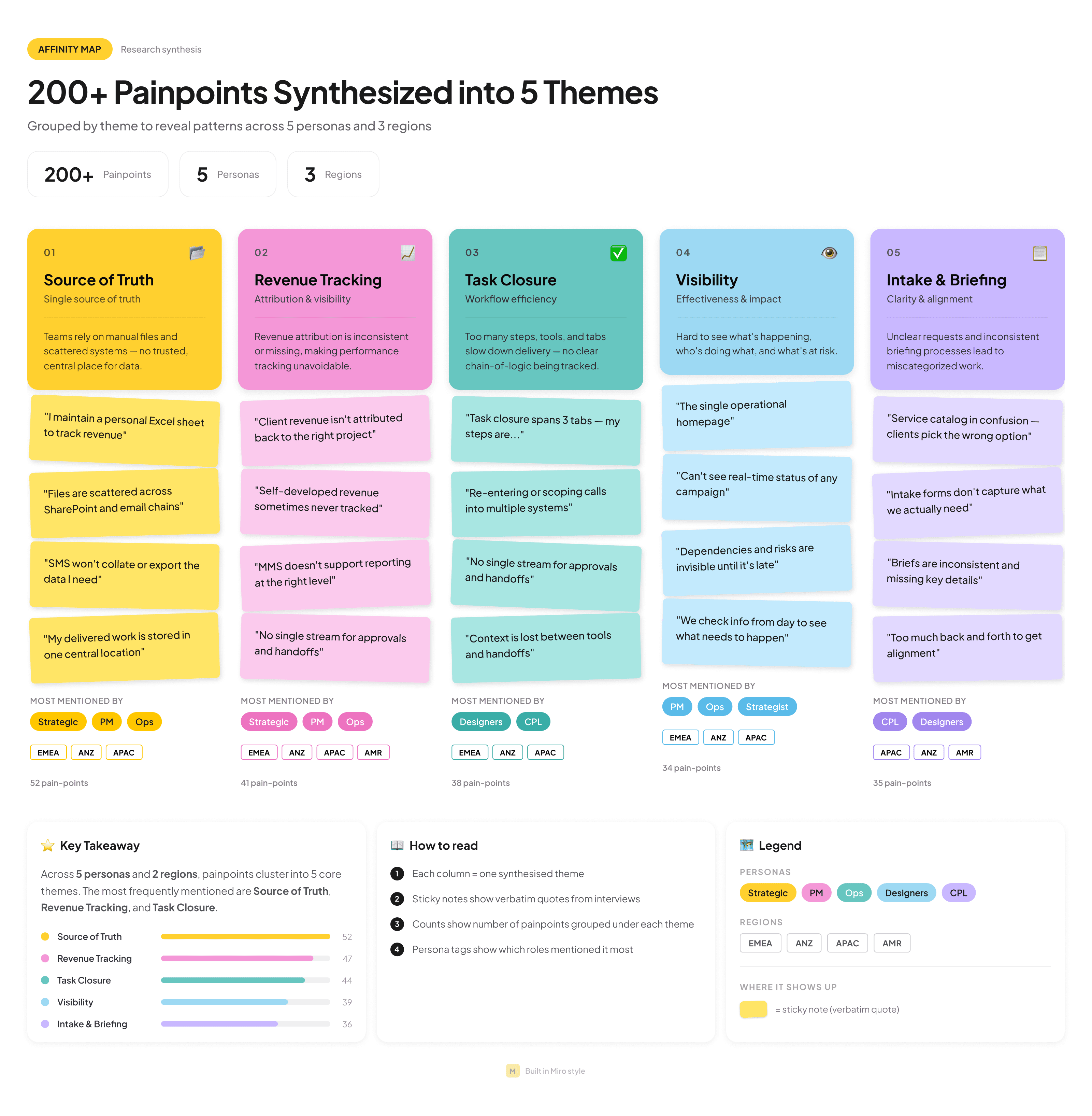
Rather than leaving findings as loose interview notes, every individual painpoint was logged as a structured insight with a consistent schema: region, persona, insight category, the verbatim painpoint, a proposed solution direction, whether the root cause was the RMS platform or a surrounding process, a topic category, and a user/business priority rating. This structure is what let us move from “200+ individual complaints” to “5 systemic themes” without losing the evidence trail back to source.
Rather than leaving findings as loose interview notes, every individual painpoint was logged as a structured insight with a consistent schema: region, persona, insight category, the verbatim painpoint, a proposed solution direction, whether the root cause was the RMS platform or a surrounding process, a topic category, and a user/business priority rating. This structure is what let us move from “200+ individual complaints” to “5 systemic themes” without losing the evidence trail back to source.
Field | Purpose |
|---|---|
| Region / Persona | Enabled cross-cutting analysis, identifying which pains were universal vs. localized |
| Painpoint / Feedback | Verbatim or close paraphrase, preserving the user’s own framing |
| RMS or Process? | Separated platform fixes from organizational/workflow fixes, critical for scoping design vs. ops recommendations |
| User / Biz Priority | Allowed us to weigh user pain against business impact independently before merging into one roadmap view |
Field | Purpose |
|---|---|
| Region / Persona | Enabled cross-cutting analysis, identifying which pains were universal vs. localized |
| Painpoint / Feedback | Verbatim or close paraphrase, preserving the user’s own framing |
| RMS or Process? | Separated platform fixes from organizational/workflow fixes, critical for scoping design vs. ops recommendations |
| User / Biz Priority | Allowed us to weigh user pain against business impact independently before merging into one roadmap view |
Across the full research set, roughly 78–80% of logged issues across every persona were attributable to the RMS platform itself rather than surrounding process, which gave us a clear, evidence-backed mandate: this was a product problem, not just a training or adoption problem.
3. From Insight to Interface: Design Process
3. From Insight to Interface: Design Process
3. From Insight to Interface: Design Process
Research alone doesn’t produce a product. This section shows the connective tissue between the insight log and the final screens: how user journeys exposed where the system broke, how a service blueprint located those breaks structurally, how the information architecture was re-rooted, and how concepts were evaluated and matured across fidelity before any pixel was polished.
Research alone doesn’t produce a product. This section shows the connective tissue between the insight log and the final screens: how user journeys exposed where the system broke, how a service blueprint located those breaks structurally, how the information architecture was re-rooted, and how concepts were evaluated and matured across fidelity before any pixel was polished.
Mapping the journey to find the breakpoints
Plotting the Strategist’s end-to-end journey made one thing obvious: the emotional low points weren’t random, they landed precisely where RMS forced a hand-off to a shadow system. Those hand-offs became the redesign’s first targets.
Plotting the Strategist’s end-to-end journey made one thing obvious: the emotional low points weren’t random, they landed precisely where RMS forced a hand-off to a shadow system. Those hand-offs became the redesign’s first targets.


Figure. Journey map: Strategist experience requesting and tracking a project. Frustration peaks map one-to-one onto the moments RMS pushes work into email, Excel, Jira, or SharePoint.
Figure. Journey map: Strategist experience requesting and tracking a project. Frustration peaks map one-to-one onto the moments RMS pushes work into email, Excel, Jira, or SharePoint.
Figure. Journey map: Strategist experience requesting and tracking a project. Frustration peaks map one-to-one onto the moments RMS pushes work into email, Excel, Jira, or SharePoint.
Locating the breaks with a service blueprint
A journey shows what the user feels; a service blueprint shows why. Mapping front-stage actions against the back-stage work and systems beneath them revealed the structural root cause: the steps that mattered most were happening below the line of visibility, in tools RMS couldn’t see.
A journey shows what the user feels; a service blueprint shows why. Mapping front-stage actions against the back-stage work and systems beneath them revealed the structural root cause: the steps that mattered most were happening below the line of visibility, in tools RMS couldn’t see.
Figure. Service blueprint: intake to reuse. The critical work consistently happens below the line of visibility, in Outlook, Jira, Slack, Excel and SharePoint, which is precisely why RMS lost its authority as the record.

Re-rooting information architecture
The legacy IA organized RMS by system function, eight-plus top-level menus (Capacity Dashboard, Studio dashboard, PM Dashboard, Team schedule, Administration, and more), each with its own nested dropdowns, as the real navigation below shows. But no persona thinks in modules; they think in jobs. We re-rooted navigation around a persona-aware home, with shared modules surfaced contextually rather than as top-level tabs, and modelled the new conversational intake as an explicit end-to-end flow.
The legacy IA organized RMS by system function, eight-plus top-level menus (Capacity Dashboard, Studio dashboard, PM Dashboard, Team schedule, Administration, and more), each with its own nested dropdowns, as the real navigation below shows. But no persona thinks in modules; they think in jobs. We re-rooted navigation around a persona-aware home, with shared modules surfaced contextually rather than as top-level tabs, and modelled the new conversational intake as an explicit end-to-end flow.

Figure. Journey map: Strategist experience requesting and tracking a project. Frustration peaks map one-to-one onto the moments RMS pushes work into email, Excel, Jira, or SharePoint.
Figure. Journey map: Strategist experience requesting and tracking a project. Frustration peaks map one-to-one onto the moments RMS pushes work into email, Excel, Jira, or SharePoint.
Figure. Journey map: Strategist experience requesting and tracking a project. Frustration peaks map one-to-one onto the moments RMS pushes work into email, Excel, Jira, or SharePoint.

Figure. Legacy RMS (before redesign): the actual pre-redesign navigation and “All projects” list. Eight-plus module-organized dropdowns and a flat list of 306,254 results: the module-not-persona IA, and the findability problem, in their original form.
Figure. Legacy RMS (before redesign): the actual pre-redesign navigation and “All projects” list. Eight-plus module-organized dropdowns and a flat list of 306,254 results: the module-not-persona IA, and the findability problem, in their original form.
Figure. Legacy RMS (before redesign): the actual pre-redesign navigation and “All projects” list. Eight-plus module-organized dropdowns and a flat list of 306,254 results: the module-not-persona IA, and the findability problem, in their original form.
Maturing the design across fidelity
Each design moved deliberately from structure to hierarchy to final fidelity. Crucially, visual polish was withheld until the underlying structure was validated, so we never spent colour and craft on a layout that hadn’t earned it yet.
Each design moved deliberately from structure to hierarchy to final fidelity. Crucially, visual polish was withheld until the underlying structure was validated, so we never spent colour and craft on a layout that hadn’t earned it yet.


Figure. Concept → iteration → final: the PM project record across three fidelity stages. Each step answered one open question (completeness, then hierarchy, then semantics) before adding the next layer of fidelity.
Figure. Concept → iteration → final: the PM project record across three fidelity stages. Each step answered one open question (completeness, then hierarchy, then semantics) before adding the next layer of fidelity.
Figure. Concept → iteration → final: the PM project record across three fidelity stages. Each step answered one open question (completeness, then hierarchy, then semantics) before adding the next layer of fidelity.
Evaluating concepts against real constraints
The strongest idea wasn’t the first idea. Before committing to conversational intake, three directions were scored with stakeholders against the constraints that actually mattered, client adoption, engineering lift, and how faithfully each fed RMS as the system of record.
The strongest idea wasn’t the first idea. Before committing to conversational intake, three directions were scored with stakeholders against the constraints that actually mattered, client adoption, engineering lift, and how faithfully each fed RMS as the system of record.

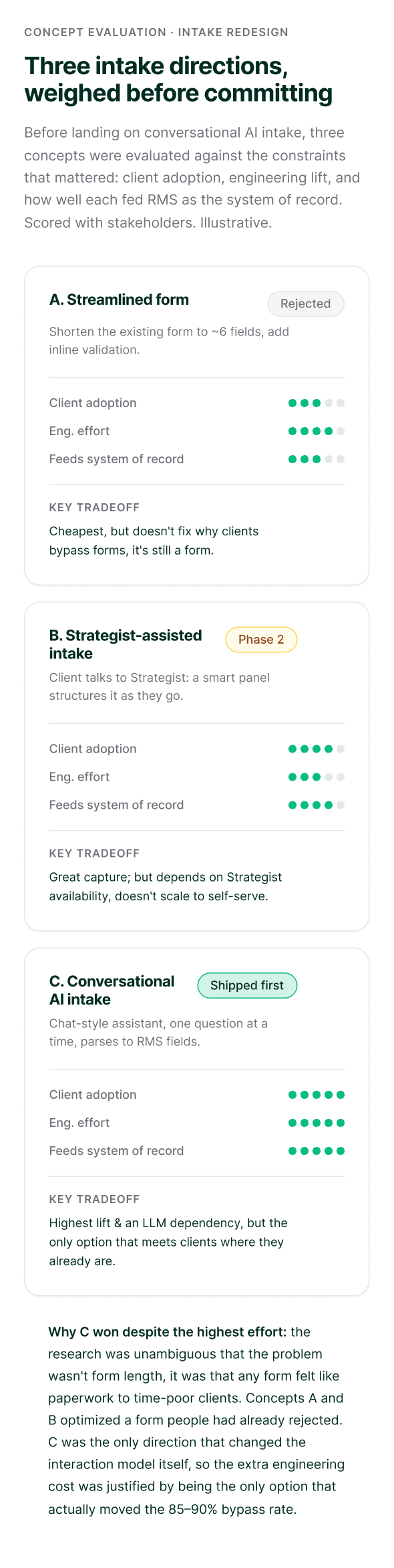

Figure. Concept evaluation: three intake directions weighed against weighted criteria. The highest-effort option won because it was the only one that changed the interaction model clients had already rejected.
Figure. Concept evaluation: three intake directions weighed against weighted criteria. The highest-effort option won because it was the only one that changed the interaction model clients had already rejected.
Figure. Concept evaluation: three intake directions weighed against weighted criteria. The highest-effort option won because it was the only one that changed the interaction model clients had already rejected.
4. Key Findings
4. Key Findings
4. Key Findings
Five themes recurred across every persona, region, and interview. They are presented in the order they drove design priority.
Five themes recurred across every persona, region, and interview. They are presented in the order they drove design priority.
RMS Is Not the Source of Truth
Every persona, independently, had built a shadow system to compensate for not trusting RMS. Strategists kept personal revenue spreadsheets. PMs followed up with each other by Slack rather than trusting the dashboard. Designers tracked real task status in Jira because RMS couldn’t represent the day-to-day granularity their work required.
Every persona, independently, had built a shadow system to compensate for not trusting RMS. Strategists kept personal revenue spreadsheets. PMs followed up with each other by Slack rather than trusting the dashboard. Designers tracked real task status in Jira because RMS couldn’t represent the day-to-day granularity their work required.
This was the meta-finding that reframed the whole project: most of the individual complaints (search, hours, visibility) were symptoms of one root issue: RMS had lost the trust required to be authoritative, so people stopped feeding it accurate data, which made it even less trustworthy. A self-reinforcing decline.
This was the meta-finding that reframed the whole project: most of the individual complaints (search, hours, visibility) were symptoms of one root issue: RMS had lost the trust required to be authoritative, so people stopped feeding it accurate data, which made it even less trustworthy. A self-reinforcing decline.

Revenue & Budget Tracking Are Broken
Hours logged in RMS rarely reflected hours actually worked. Designers placed time blockers that didn’t match real effort, updated them at most once a week, and revenue generated through a Strategist’s own business development frequently wasn’t attributed back to them, directly undermining a metric tied to their performance.
Hours logged in RMS rarely reflected hours actually worked. Designers placed time blockers that didn’t match real effort, updated them at most once a week, and revenue generated through a Strategist’s own business development frequently wasn’t attributed back to them, directly undermining a metric tied to their performance.
“Clients I’ve developed relationships with go directly into RMS without my name attached, meaning revenue I generated through business development doesn’t get tracked back to me. A recurring and significant problem.”
- Marc, Strategist, AMR
“Clients I’ve developed relationships with go directly into RMS without my name attached, meaning revenue I generated through business development doesn’t get tracked back to me. A recurring and significant problem.”
- Marc, Strategist, AMR
For Account teams, this meant they could never confidently tell a client how much budget had actually been spent on a given day, a direct hit to client trust, not just internal tidiness.
For Account teams, this meant they could never confidently tell a client how much budget had actually been spent on a given day, a direct hit to client trust, not just internal tidiness.

Figure. Concept evaluation: three intake directions weighed against weighted criteria. The highest-effort option won because it was the only one that changed the interaction model clients had already rejected.
Figure. Concept evaluation: three intake directions weighed against weighted criteria. The highest-effort option won because it was the only one that changed the interaction model clients had already rejected.
Figure. Concept evaluation: three intake directions weighed against weighted criteria. The highest-effort option won because it was the only one that changed the interaction model clients had already rejected.
Search, Navigation & Discovery Are Broken
Strategists could not reliably find past projects due to inconsistent naming, weak filtering, and slow load times. Compounding this, delivered work itself was never centrally stored in RMS. It lived scattered across SharePoints and personal drives, meaning even when a project record was found, the actual output usually wasn’t.
Strategists could not reliably find past projects due to inconsistent naming, weak filtering, and slow load times. Compounding this, delivered work itself was never centrally stored in RMS. It lived scattered across SharePoints and personal drives, meaning even when a project record was found, the actual output usually wasn’t.

Intake & Briefing Fails Both Clients and Teams
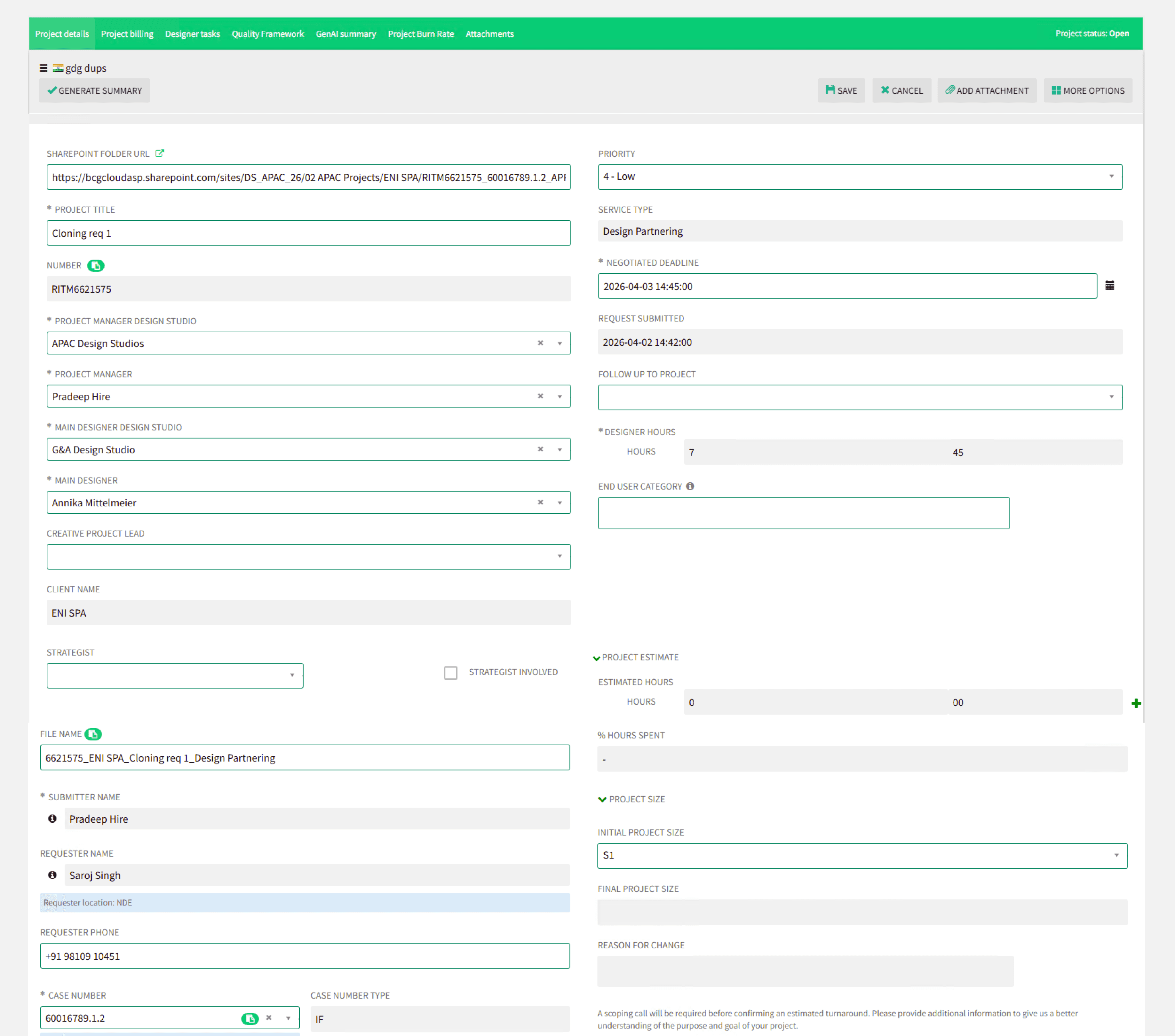
85–90% of requests bypassed the formal RMS brief entirely. Clients found the form too slow and impersonal for how time-poor they were, so they defaulted to emailing or messaging a Strategist directly, which meant the brief, when it existed at all, was reconstructed after the fact rather than captured at the point of need. CPLs separately described a service catalog so confusing that clients routinely mis-categorized their own requests.
85–90% of requests bypassed the formal RMS brief entirely. Clients found the form too slow and impersonal for how time-poor they were, so they defaulted to emailing or messaging a Strategist directly, which meant the brief, when it existed at all, was reconstructed after the fact rather than captured at the point of need. CPLs separately described a service catalog so confusing that clients routinely mis-categorized their own requests.

No Visibility Into Capacity, Status, or History
No persona had a home in RMS that reflected their actual job. Strategists wanted a personalized view of their clients and projects. CPLs wanted real-time team capacity instead of routing every staffing question through Ops. Managers wanted burnout-aware capacity views across their direct reports. PMs, 79% of whose feedback lacked even an explicit priority rating, itself a signal of how unstructured this pain was, wanted one operational homepage instead of stitching together Jira, Slack, and RMS by hand.
No persona had a home in RMS that reflected their actual job. Strategists wanted a personalized view of their clients and projects. CPLs wanted real-time team capacity instead of routing every staffing question through Ops. Managers wanted burnout-aware capacity views across their direct reports. PMs, 79% of whose feedback lacked even an explicit priority rating, itself a signal of how unstructured this pain was, wanted one operational homepage instead of stitching together Jira, Slack, and RMS by hand.


5. Synthesis & Prioritization
5. Synthesis & Prioritization
5. Synthesis & Prioritization
With 200+ logged insights, the risk was treating every painpoint as equally urgent. Instead, each insight carried two independent priority signals, user priority and business priority, plus a platform-vs-process classification, which let us separate “what hurts the most” from “what’s cheapest to fix” before committing to a roadmap.
With 200+ logged insights, the risk was treating every painpoint as equally urgent. Instead, each insight carried two independent priority signals, user priority and business priority, plus a platform-vs-process classification, which let us separate “what hurts the most” from “what’s cheapest to fix” before committing to a roadmap.
The Prioritization Lens
Frequency: how many distinct people, across how many regions, raised the same root issue independently
Frequency: how many distinct people, across how many regions, raised the same root issue independently
Platform vs. process: a platform fix is a design and engineering commitment; a process fix is an operational change. Conflating the two leads to roadmaps that promise more than design alone can deliver
Platform vs. process: a platform fix is a design and engineering commitment; a process fix is an operational change. Conflating the two leads to roadmaps that promise more than design alone can deliver
User priority vs. business priority: a painpoint can be a daily irritant for users without being commercially urgent, and vice versa. We tracked both rather than collapsing them into one number prematurely
User priority vs. business priority: a painpoint can be a daily irritant for users without being commercially urgent, and vice versa. We tracked both rather than collapsing them into one number prematurely
Effort/complexity: separating “high-impact, low-effort” quick wins from structural rebuilds that needed a multi-quarter investment case
Effort/complexity: separating “high-impact, low-effort” quick wins from structural rebuilds that needed a multi-quarter investment case
What This Produced, by Persona
Persona | RMS Share | #1 Strategic Recommendation |
|---|---|---|
| Strategist | 109 of 149 | Make RMS the single source of truth by integrating Jira, Slack, and SharePoint so status and deliverables sync automatically |
| CPL | 65 of 81 | Integrate Outlook Calendar to auto-sync meetings, scoping calls, and blockers. The #1 time sink across all 12 CPLs |
| Designer | ~78% | Build a unified task closure flow, embedding GenAI usage, Quality Framework, and ticket closing into one inline action |
| Manager | N/A | Create manager-centric dashboards with team capacity, burnout alerts, and direct-report status in one view |
| PM / Ops | 170 of 213 | Rebuild the Team Schedule as a staffing command center, unifying capacity, skills, and availability across regions |
The pattern across every row is not coincidental: each persona’s top recommendation is a variant of the same underlying move: stop asking people to manually reconcile RMS with the tools they actually trust, and let RMS absorb that integration work instead. That convergence is what let five separate persona roadmaps collapse into one coherent platform strategy rather than five competing backlogs.
The pattern across every row is not coincidental: each persona’s top recommendation is a variant of the same underlying move: stop asking people to manually reconcile RMS with the tools they actually trust, and let RMS absorb that integration work instead. That convergence is what let five separate persona roadmaps collapse into one coherent platform strategy rather than five competing backlogs.


6. From Research to Design
6. From Research to Design
6. From Research to Design
Every major design decision maps back to a finding above, but a finding alone doesn’t justify a design. Each move below is framed as the team actually navigated it: the problem, the constraints that bounded the solution space, the tradeoff that had to be accepted, and the decision that resulted. None of these shipped without cost.
Every major design decision maps back to a finding above, but a finding alone doesn’t justify a design. Each move below is framed as the team actually navigated it: the problem, the constraints that bounded the solution space, the tradeoff that had to be accepted, and the decision that resulted. None of these shipped without cost.
Conversational, AI-Guided Intake
Problem. 85–90% of requests bypassed the RMS brief form because it was too slow and impersonal for time-poor clients, and a 40+ option service taxonomy meant clients mis-categorized their own requests.
Constraint
Constraint
No control over the LLM’s accuracy on first release: a parsing error that mis-scopes a brief erodes the very trust we’re trying to rebuild.
No control over the LLM’s accuracy on first release: a parsing error that mis-scopes a brief erodes the very trust we’re trying to rebuild.
Clients sit outside BCG’s SSO in many cases, so the intake had to work for low-auth external users without leaking internal taxonomy.
Clients sit outside BCG’s SSO in many cases, so the intake had to work for low-auth external users without leaking internal taxonomy.
Tradeoff
Tradeoff
A fully conversational flow carried the highest engineering lift and an ongoing LLM dependency, versus simply shortening the existing form, which was nearly free but wouldn’t change behaviour.
A fully conversational flow carried the highest engineering lift and an ongoing LLM dependency, versus simply shortening the existing form, which was nearly free but wouldn’t change behaviour.
Decision
Decision
Ship conversational intake, but keep every AI-inferred field editable and show the parsed result inline so the human always confirms before the brief is committed. The extra build cost was justified because it was the only option that addressed why clients bypass forms, not just how long they are.
Ship conversational intake, but keep every AI-inferred field editable and show the parsed result inline so the human always confirms before the brief is committed. The extra build cost was justified because it was the only option that addressed why clients bypass forms, not just how long they are.

Figure. Left: the actual legacy RMS intake/brief form the redesign replaces, dense, all-fields-up-front, the artifact 85–90% of clients abandoned. Right: the conversational intake that asks one question at a time, infers the service type, and lands a structured brief in RMS.
Figure. Left: the actual legacy RMS intake/brief form the redesign replaces, dense, all-fields-up-front, the artifact 85–90% of clients abandoned. Right: the conversational intake that asks one question at a time, infers the service type, and lands a structured brief in RMS.
A Unified Task Closure Flow
Problem. Designers described task closure as a multi-step nightmare. GenAI usage logging, the Quality Framework, and ticket closing lived in separate tabs, so steps were routinely skipped.
Constraint
Constraint
The Quality Framework is owned by a separate governance group with its own data model; we couldn’t simply restyle it, only embed it.
The Quality Framework is owned by a separate governance group with its own data model; we couldn’t simply restyle it, only embed it.
Mandatory GenAI-usage logging is a compliance requirement, so it can’t be made optional to streamline the flow.
Mandatory GenAI-usage logging is a compliance requirement, so it can’t be made optional to streamline the flow.
Tradeoff
Tradeoff
Collapsing three governance-owned steps into one inline action risked oversimplifying fields each owning team cared about, versus leaving them separate and accepting the skip-rate.
Collapsing three governance-owned steps into one inline action risked oversimplifying fields each owning team cared about, versus leaving them separate and accepting the skip-rate.
Decision
Decision
Embed all three as one inline closure action with a bulk-close pattern, preserving each owner’s required fields but surfacing them at the single moment of finishing a task. The highest-leverage Designer fix, addressing the top pain of 6+ of 12 designers.
Embed all three as one inline closure action with a bulk-close pattern, preserving each owner’s required fields but surfacing them at the single moment of finishing a task. The highest-leverage Designer fix, addressing the top pain of 6+ of 12 designers.
Media. After: the unified Designer Tasks surface (left) captures GenAI use, billing status, hours, service type and status inline in one row-level action; the Kanban form (right) supports bulk-close for high project volumes.
Media. After: the unified Designer Tasks surface (left) captures GenAI use, billing status, hours, service type and status inline in one row-level action; the Kanban form (right) supports bulk-close for high project volumes.
Outlook Calendar as a First-Class Integration
Problem. Every persona manually re-entered meetings, scoping calls, and blockers into RMS because no calendar sync existed. CPLs named this their #1 time sink.
Constraint
Constraint
Two-way sync against Microsoft Graph has rate limits and permission scopes that vary by region’s IT policy, so a global rollout couldn’t assume uniform access.
Two-way sync against Microsoft Graph has rate limits and permission scopes that vary by region’s IT policy, so a global rollout couldn’t assume uniform access.
Designers were wary of an integration that might expose private calendar detail to managers, a trust and privacy line we could not cross.
Designers were wary of an integration that might expose private calendar detail to managers, a trust and privacy line we could not cross.
Tradeoff
Tradeoff
Real-time bidirectional sync is the ideal but is the heaviest build and the most permission-sensitive; one-way read with manual confirmation is lighter but leaves some double-entry.
Real-time bidirectional sync is the ideal but is the heaviest build and the most permission-sensitive; one-way read with manual confirmation is lighter but leaves some double-entry.
Decision
Decision
Build two-way sync with one-click confirmation for auto-detected blockers, surfacing only busy/free and work events, never private detail. Treated as foundational infrastructure because it touched every persona’s top recommendation, not a single-persona feature.
Build two-way sync with one-click confirmation for auto-detected blockers, surfacing only busy/free and work events, never private detail. Treated as foundational infrastructure because it touched every persona’s top recommendation, not a single-persona feature.
Persona-Specific Homepages
Problem. No persona had a default RMS view that reflected their actual job; each reconstructed their own signal elsewhere.
Constraint
Constraint
Five fully bespoke homepages would be unmaintainable for one engineering team and would fork the design system over time.
Five fully bespoke homepages would be unmaintainable for one engineering team and would fork the design system over time.
Personalization had to degrade gracefully for users who span two roles (a PM who also runs Ops), without forcing them to choose one identity.
Personalization had to degrade gracefully for users who span two roles (a PM who also runs Ops), without forcing them to choose one identity.
Tradeoff
Tradeoff
Five tailored experiences maximize per-persona relevance but multiply build and maintenance cost; one generic dashboard is cheap but reproduces the “no home reflects my job” problem.
Five tailored experiences maximize per-persona relevance but multiply build and maintenance cost; one generic dashboard is cheap but reproduces the “no home reflects my job” problem.
Decision
Decision
Build one shared component system that flexes into five configurations, so the Strategist’s revenue lens and the Manager’s capacity lens are configurations, not rebuilds, with a My View / Studio View toggle for dual-role users.
Build one shared component system that flexes into five configurations, so the Strategist’s revenue lens and the Manager’s capacity lens are configurations, not rebuilds, with a My View / Studio View toggle for dual-role users.
Media. Persona homepage: the PM “My View” (left) leads with the PM’s own projects, deadlines and burn rate; the same component system reconfigures into the studio-wide “Studio View” (right) for overdue, unassigned and routed work.
Media. Persona homepage: the PM “My View” (left) leads with the PM’s own projects, deadlines and burn rate; the same component system reconfigures into the studio-wide “Studio View” (right) for overdue, unassigned and routed work.

Remaining persona variants
Strategist home: leads with client portfolio and BD-attributed revenue, with the personal project list secondary.
Strategist home: leads with client portfolio and BD-attributed revenue, with the personal project list secondary.
CPL home: leads with real-time team capacity and the scoping-call queue rather than routing staffing questions through Ops.
CPL home: leads with real-time team capacity and the scoping-call queue rather than routing staffing questions through Ops.
Manager home: leads with burnout-aware capacity across direct reports and per-report status roll-ups.
Manager home: leads with burnout-aware capacity across direct reports and per-report status roll-ups.
Shown side by side, the five demonstrate the shared component system flexing to each persona’s primary job-to-be-done.
Shown side by side, the five demonstrate the shared component system flexing to each persona’s primary job-to-be-done.
Smarter, Client-Aware Search
Problem. Strategists could not reliably find past projects, and delivered work itself wasn’t centrally stored, it lived across SharePoint and personal drives.
Constraint
A decade of legacy projects have inconsistent, free-text names, with no clean metadata to index against on day one.
A decade of legacy projects have inconsistent, free-text names, with no clean metadata to index against on day one.
Centralising delivered files touches data-residency rules that differ across EMESA, AMR and APAC.
Centralising delivered files touches data-residency rules that differ across EMESA, AMR and APAC.
Tradeoff
Fixing search alone is faster but surfaces records that still point nowhere; building the linked repository too is the right fix but a far larger data-migration commitment
Fixing search alone is faster but surfaces records that still point nowhere; building the linked repository too is the right fix but a far larger data-migration commitment
Decision
Solve search and storage together: redesign search around the filters Strategists actually think in (client, practice area, project type) and pair it with a repository that links delivered work to its record, phased after the quick wins given the migration cost.
Solve search and storage together: redesign search around the filters Strategists actually think in (client, practice area, project type) and pair it with a repository that links delivered work to its record, phased after the quick wins given the migration cost.

Design rationale for the most-used screen
Because the PM project record is the single most-used screen in RMS, it carries the most design decisions, and the most risk of looking “solutionized.” Each module placement, the information hierarchy, and the interaction model trace to a specific finding rather than aesthetic preference.

Figure. Design rationale: the PM project record annotated, why each module is present, why the hierarchy puts status first, why closure is inline, and why the AI summary is given prominence.
Figure. Design rationale: the PM project record annotated, why each module is present, why the hierarchy puts status first, why closure is inline, and why the AI summary is given prominence.
One module earns special prominence: the AI Project Summary. Because PMs and Managers scan many records in quick succession, an on-demand summary surfaces the few things that decide whether a project needs attention, time to deadline, tasks pending, budget burned, and the specific risks detected, before they open and read every sub-section.
Media. The AI Project Summary in context: triggered from the project record, it slides in over the screen it summarizes and resolves a skeleton-loading state into key metrics, a natural-language status read, task progress, and a ranked list of detected risks with severity.
Media. The AI Project Summary in context: triggered from the project record, it slides in over the screen it summarizes and resolves a skeleton-loading state into key metrics, a natural-language status read, task progress, and a ranked list of detected risks with severity.
7. Outcome, Measurement & Reflection
7. Outcome, Measurement & Reflection
7. Outcome, Measurement & Reflection
What Shipped
The redesign moved RMS from a system every persona individually worked around to one built on a single principle: integrate with the tools people already trust (Jira, Slack, Outlook, SharePoint) rather than asking people to re-enter the same information twice. The conversational intake, unified task closure flow, and Outlook calendar integration shipped as the first wave, each mapped to the highest-frequency, highest-priority finding in its persona track; persona homepages and client-aware search are phased behind them.
The redesign moved RMS from a system every persona individually worked around to one built on a single principle: integrate with the tools people already trust (Jira, Slack, Outlook, SharePoint) rather than asking people to re-enter the same information twice. The conversational intake, unified task closure flow, and Outlook calendar integration shipped as the first wave, each mapped to the highest-frequency, highest-priority finding in its persona track; persona homepages and client-aware search are phased behind them.
A note on impact. The first wave shipped recently and post-launch metrics are still maturing. Rather than present projected numbers as if they were results, the framework below states the baselines established during research, the targets validated through stakeholder reviews and usability testing, and exactly how each is being measured now that instrumentation is live.
A note on impact. The first wave shipped recently and post-launch metrics are still maturing. Rather than present projected numbers as if they were results, the framework below states the baselines established during research, the targets validated through stakeholder reviews and usability testing, and exactly how each is being measured now that instrumentation is live.
Measurement Framework
The framework tracks brief completion, daily admin time, search success, BD-attribution accuracy, and support-request volume, using baselines established during research and targets validated through stakeholder reviews.
The framework tracks brief completion, daily admin time, search success, BD-attribution accuracy, and support-request volume, using baselines established during research and targets validated through stakeholder reviews.
Why frame it this way: presenting validated targets with explicit measurement methods is more honest, and more useful to the business, than reporting numbers the launch hasn’t produced yet. It also leaves a clear instrumentation plan for whoever owns RMS next.


Why frame it this way: presenting validated targets with explicit measurement methods is more honest, and more useful to the business, than reporting numbers the launch hasn’t produced yet. It also leaves a clear instrumentation plan for whoever owns RMS next.


What I’d Do Differently
Standardize priority tagging earlier. 79% of PM/Ops insights had no explicit priority rating, which meant extra synthesis work to infer relative urgency after the fact. Building the rating prompt into the interview script itself would have saved a full pass of re-analysis.
Standardize priority tagging earlier. 79% of PM/Ops insights had no explicit priority rating, which meant extra synthesis work to infer relative urgency after the fact. Building the rating prompt into the interview script itself would have saved a full pass of re-analysis.
Validate the persona-homepage concept with a clickable prototype before final visual design. Five distinct configurations is a lot of surface area to get right in a single round of stakeholder review.
Validate the persona-homepage concept with a clickable prototype before final visual design. Five distinct configurations is a lot of surface area to get right in a single round of stakeholder review.
Bring engineering into the platform-vs-process classification earlier, since several “platform” fixes (like Jira sync depth and Graph API scopes) carried very different complexity than they appeared to from the design side alone.
Bring engineering into the platform-vs-process classification earlier, since several “platform” fixes (like Jira sync depth and Graph API scopes) carried very different complexity than they appeared to from the design side alone.
What This Project Demonstrates
Designing for a 1,500+ user, three-region internal platform is fundamentally a synthesis problem before it’s a visual design problem, and a constraints problem before it’s a solution. The hardest and most valuable part of this work wasn’t any single screen. It was building a structure rigorous enough that 200+ raw insights could be defensibly compressed into five themes, and disciplined enough that every resulting design decision could be traced back to a specific person’s specific pain, navigated against a real constraint, and measured after launch.
Designing for a 1,500+ user, three-region internal platform is fundamentally a synthesis problem before it’s a visual design problem, and a constraints problem before it’s a solution. The hardest and most valuable part of this work wasn’t any single screen. It was building a structure rigorous enough that 200+ raw insights could be defensibly compressed into five themes, and disciplined enough that every resulting design decision could be traced back to a specific person’s specific pain, navigated against a real constraint, and measured after launch.